
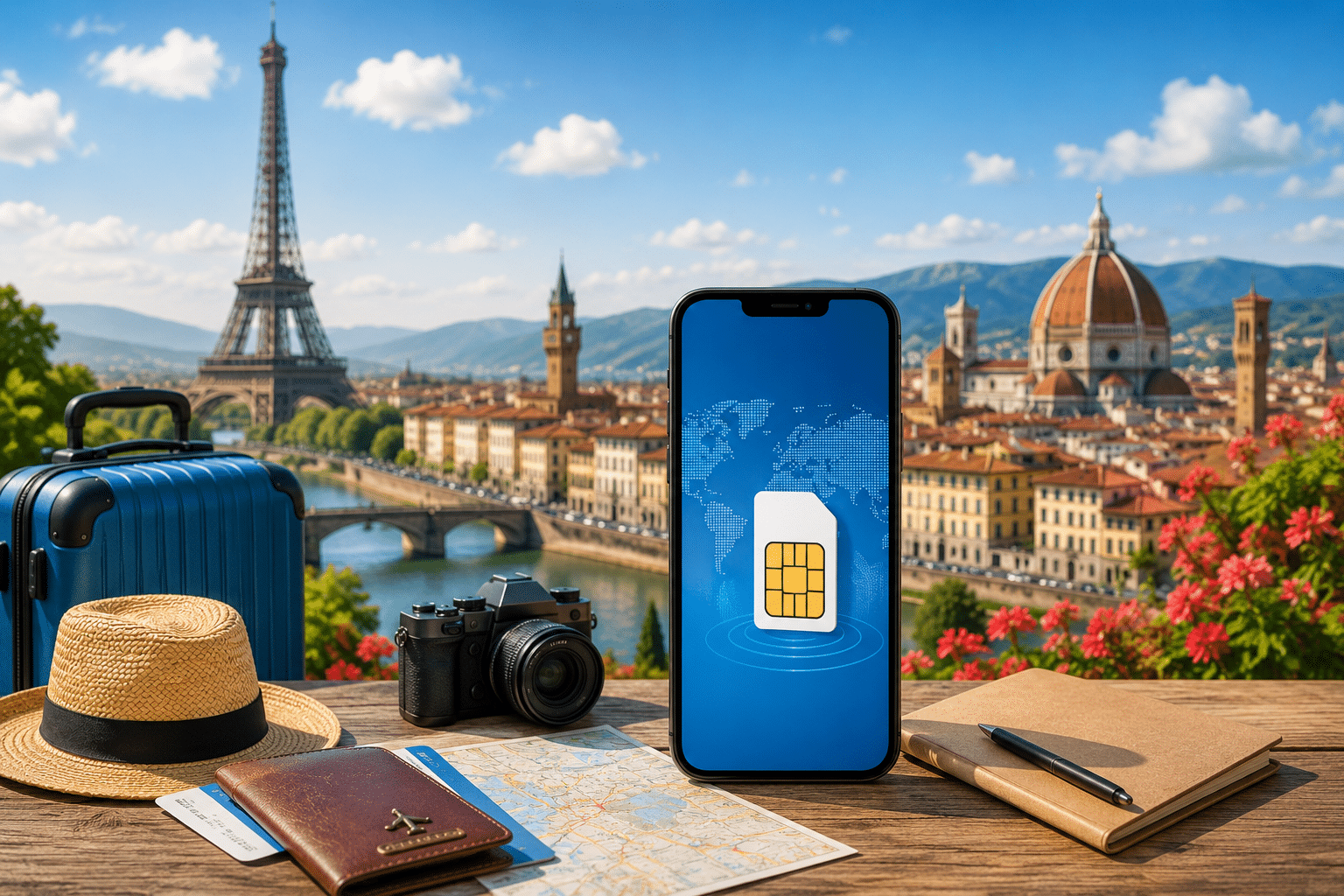
When planning a trip to Europe, many people wonder: “How much mobile data will I actually need while I’m there?” While travelers often focus on booking flights, hotels, and attractions, preparing a reliable internet connection is also an essential part of modern international travel.
Smartphones play a key role in travel—whether it’s checking directions on a map app, booking train tickets, or sharing your journey with family and friends. However, estimating the right amount of data is not always easy. Too little data can lead to frustrating restrictions during your trip, while too much means unnecessary costs.
In this article, we’ll explain estimated data usage based on travel duration and usage style, helping you enjoy a smooth and stress-free European trip.
Enjoy Your Event Stress-Free with Euro Travelo
Planning a trip to attend a festival, concert, or business event in Europe can be overwhelming—tickets, travel, accommodation, and local logistics all take time and effort. Euro Travelo makes it simple by providing everything you need through one trusted company. You save time, avoid stress, and enjoy a seamless experience from start to finish.
Why Mobile Data Is Important When Traveling in Europe
In recent years, smartphones have become an essential travel tool. Even if you are traveling with the intention of taking a “digital detox,” there are still many situations where at least basic internet access is necessary.
For example, you may need it for:
- Checking routes to your destination using Google Maps
- Searching for information about restaurants and tourist attractions
- Accessing digital tickets or boarding passes
- Communicating via LINE or WhatsApp
- Booking trains or buses
- Checking hotel reservation details
- Using translation apps
- Posting photos or videos on social media
- Staying in contact with family and friends
Especially when traveling across Europe, where you may visit multiple countries, having a stable and reliable internet connection prepared in advance brings peace of mind and convenience.
Choosing a Communication Method for Traveling in Europe
When traveling in Europe, there are several different ways to stay connected. Each option has its own advantages and disadvantages, so it’s important to choose the one that best fits your travel style and budget.
International Roaming
One of the simplest methods is to use the international roaming service provided by your mobile carrier in Japan.
The main advantage is convenience—you don’t need to replace your SIM card or sign up for a new service, and you can continue using your usual phone number after leaving Japan. Setup is generally easy, which makes it a reassuring option for travelers who are not very experienced with international travel.
However, costs can become quite high depending on usage, so it is important to check the pricing structure and available data limits in advance. It is often convenient for short trips, but for longer stays, other options may be more economical.
Pocket Wi-Fi
Pocket Wi-Fi is a method of connecting to the internet using a portable Wi-Fi router.
It allows multiple devices—such as smartphones, tablets, and laptops—to connect at the same time, making it ideal for family trips or group travel with friends. In some cases, sharing one device can also help reduce overall communication costs.
On the downside, you need to carry the router with you at all times and manage its battery life. If the battery runs out, you will lose internet access, so carrying a mobile power bank is often necessary.
Local SIM Cards
Using a SIM card provided by a local telecom operator is known for being cost-effective. It often offers relatively affordable large-data plans, making it popular among long-term travelers.
However, you usually need to purchase it at an airport or mobile shop after arrival, and you must handle the SIM card replacement and initial setup yourself. It also requires your phone to be SIM-unlocked, so you should check compatibility in advance.
For those who are comfortable handling setup procedures abroad or want to minimize costs, this can be a strong option.
eSIM (The Most Convenient Option)
In recent years, eSIMs have rapidly become popular among travelers to Europe. The biggest advantage is that there is no need to physically replace a SIM card, and activation can be done instantly online.
One of the most notable providers is Saily.
What is Saily?
Saily is an eSIM service provided by Nord Security, the global cybersecurity company behind NordVPN.
Built on security technology developed through Nord Security’s experience, Saily focuses on providing safe and stable connectivity for travelers.
Key Features of Saily
- eSIM plans available across multiple countries, including Europe
- Easy installation and management via a mobile app
- No physical SIM required—use starts immediately upon arrival
- Simple, data-focused pricing structure
- Flexible plans designed specifically for travelers
It is especially well-suited for multi-country trips across Europe, as it continues to work seamlessly even when crossing borders.
By setting it up before your trip, you can access the internet immediately upon arrival, without needing to search for a SIM card at the airport.
If you want to compare options in more detail, checking a guide on recommended European SIM cards can help you find the communication method that best suits your needs.
Key Factors That Affect Data Usage
The amount of mobile data you need can vary significantly depending on your travel habits and how you use your smartphone. Whether you are on a short sightseeing trip or a long-term stay will also change the ideal plan. To choose the right communication option, it is important to understand what affects data consumption.
1. Travel Duration
The most obvious factor is the number of days you stay in Europe. Naturally, the longer your trip, the more often you will use your smartphone, and the more data you will need.
For example, a short weekend trip of 2–3 days usually involves basic usage such as map checking and messaging, so a relatively small amount of data may be enough.
On the other hand, trips longer than two weeks or month-long stays involve frequent activities such as searching for tourist information, booking transportation, and sharing photos, which require much larger data allowances.
Understanding your needs based on travel duration helps you choose a plan more efficiently without overpaying or running out of data.
2. Social Media Usage
How often you use platforms like Instagram, TikTok, Facebook, and X (formerly Twitter) has a major impact on your data consumption.
Travelers who frequently post photos or videos of scenic views and food should be especially careful. Uploading photos does not consume much data, but uploading high-resolution videos or live streaming can use a large amount.
Even if you are not posting yourself, simply watching stories or short-form videos for extended periods can significantly increase data usage. If you enjoy social media heavily, choosing a plan with more data is recommended.
3. Map App Usage
During international travel, map applications like Google Maps are extremely useful for navigation, finding restaurants, and exploring new cities.
While map apps themselves do not consume much data, frequent daily use or traveling across multiple cities can gradually increase overall usage.
Continuous navigation with real-time location tracking may use more data than simply viewing maps. To save data, downloading offline maps in advance is a practical solution.
4. Video Streaming Usage
One of the biggest factors affecting data consumption is video streaming.
Services like YouTube, Netflix, and Amazon Prime Video consume large amounts of data even in a short time. Watching videos in high resolution can quickly use several gigabytes of data.
Short-form content such as TikTok videos or Instagram Reels can also lead to unexpectedly high usage due to long viewing sessions.
If you plan to watch videos during travel or in your hotel, a high-data or unlimited plan is highly recommended.
5. Quality of Wi-Fi Availability
The availability and reliability of Wi-Fi at your accommodation or destinations also plays an important role in determining how much mobile data you need.
If your hotel, hostel, or cafés offer stable Wi-Fi, you can perform tasks like app updates, photo backups, and large downloads over Wi-Fi, significantly reducing mobile data usage.
However, if you are traveling in areas with weak or inconsistent Wi-Fi—or if you are frequently on the move—it is safer to have a larger mobile data allowance.
In multi-country Europe trips, Wi-Fi quality can vary from place to place, so it is best not to rely on it completely and to prepare sufficient mobile data in advance.
Estimated Data Usage by Activity
Low Data Usage Activities
- Sending messages via LINE or WhatsApp
- Checking emails
- Browsing websites
- Text-based searches
These activities consume relatively little data.
Moderate Data Usage Activities
- Using Google Maps
- Uploading photos
- Short video calls
- Browsing social media
These are common travel activities that require a moderate amount of data.
High Data Usage Activities
- Streaming video services
- Long YouTube viewing sessions
- Uploading high-resolution videos
- Participating in online meetings
If you frequently use these services, it is recommended to choose a high-data or unlimited plan.
Recommended Data Allowance by Travel Duration
2–4 Days (Short Trip)
Recommended: 3GB–5GB
For a weekend trip to Europe, basic usage is usually enough, such as:
- Using map apps
- Sending and receiving messages
- Searching for travel information
- Posting a few photos
In many cases, around 3GB is sufficient. If you plan to use social media more actively, around 5GB is safer.
5–8 Days (One-Week Trip)
Recommended: 5GB–10GB
For a typical one-week trip to Europe, 5GB–10GB is a good benchmark.
This suits travelers who use their phones for:
- Daily navigation
- Finding restaurants
- Booking transport
- Communicating with family and friends
- Regular social media posting
10–14 Days (Two-Week Trip)
Recommended: 10GB–20GB
On multi-city trips, smartphone usage naturally increases.
This type of traveler often uses:
- Daily map navigation
- Frequent photo sharing
- Searching for tourist information
- Video calls
For this reason, a plan around 15GB is often ideal.
3 Weeks or Longer (Long-Term Stay)
Recommended: 20GB–50GB
For long trips or extended stays, data usage increases significantly.
This includes:
- Backpackers
- Working holiday travelers
- Students
- Digital nomads
For these users, a plan with 20GB or more is recommended for peace of mind.
Do You Need an Unlimited Plan?
Many travelers wonder whether an “unlimited data plan” is necessary.
Unlimited plans are best suited for:
- Remote workers
- Heavy video streamers
- Travelers with limited access to Wi-Fi
- Long-term visitors in Europe
However, for most tourists, 10GB–20GB is often enough depending on usage habits.
Choosing the right plan based on your personal travel style is the most important factor.
Tips to Save Mobile Data While Traveling
In Europe, you don’t necessarily need a very large data plan if you manage your usage wisely. With a few simple habits, you can significantly reduce data consumption. This is especially useful when traveling across multiple countries, where efficient data management helps you stay connected without worrying about running out. Below are practical ways to save data during your trip.
Use Offline Maps
During international travel, Google Maps is one of the most frequently used apps—for navigating from hotels to attractions, finding restaurants, and checking public transport routes.
Google Maps offers an “offline maps” feature that allows you to download map data in advance. By saving maps of your destination cities before leaving your home country, you can access navigation and basic route search even without an internet connection.
This reduces the need to load maps repeatedly using mobile data, especially useful for multi-city Europe trips. Downloading key cities in advance is highly recommended.
Use Hotel Wi-Fi Effectively
Wi-Fi provided by your accommodation is a powerful tool for saving mobile data. Try to perform data-heavy tasks—such as app updates, photo backups, and video streaming—while connected to Wi-Fi.
Travelers often take many photos and videos, and automatic backup settings can quietly consume large amounts of data. It is better to back up files when you return to your hotel and are connected to Wi-Fi.
You can also use this time to search for next-day travel plans or check transportation schedules, reducing the need for mobile data while outdoors.
Turn Off Social Media Auto-Play
Apps like Instagram, Facebook, X (formerly Twitter), and TikTok often have video auto-play enabled by default. While convenient, this feature can consume a significant amount of data without you noticing.
If you frequently check social media during short breaks, simply disabling auto-play can reduce data usage significantly.
Most apps allow you to change this in the settings. It’s a good idea to adjust these settings before your trip and only play videos when needed.
Download Music and Videos in Advance
Many travelers enjoy watching movies or listening to music during flights or long train journeys. However, streaming content on the go can consume a large amount of data.
Services like Spotify, Netflix, and Amazon Prime Video allow users to download content for offline use.
By downloading playlists, movies, or shows before departure, you can enjoy entertainment during travel without using mobile data. This is especially useful for long-distance travel in Europe.
Monitor Your Data Usage
One of the most important steps in saving data is understanding how much you are actually using.
Both iPhone and Android devices have built-in tools to track data consumption. During your trip, check your usage regularly to ensure you are staying within your limit.
If you notice higher-than-expected usage, you can adjust by reducing video streaming or relying more on Wi-Fi. Monitoring your usage helps prevent unexpected data shortages during your trip.
What Type of Traveler Are You?
Data needs vary greatly depending on how you use your smartphone. Choosing the wrong plan may result in either running out of data or wasting money on unused capacity. That’s why it’s important to understand your travel style. Below are four common traveler types and their recommended data usage.
Light User
Light users use smartphones only for essential tasks such as messaging, navigation, and basic travel searches.
They rarely post on social media and usually avoid video streaming. They also tend to use hotel or café Wi-Fi whenever possible.
Recommended data: 3GB–5GB
This is usually enough for short trips and budget-conscious travelers.
Regular Traveler
Regular travelers use their smartphones actively while sightseeing. They search for restaurants and attractions, share photos on social media, and stay in touch with family and friends.
They may also watch short videos occasionally, making their data usage higher than light users.
Recommended data: 5GB–15GB
This range is suitable for most one-week trips to Europe.
Heavy Social Media User
Heavy social media users actively share their travel experiences online, posting photos and videos in real time.
They also spend significant time watching short-form content like Instagram Reels and TikTok videos, which can quickly increase data usage.
High-resolution uploads also consume more data per post.
Recommended data: 15GB–30GB
This range is ideal for social-media-focused travel, especially for longer trips.
Remote Worker
Remote workers continue working during their travels. They rely on stable internet for video meetings, email communication, and cloud-based file sharing.
Video conferencing tools like Zoom or Google Meet consume significant data, especially during long meetings. Large file transfers can also increase usage.
Recommended data: 30GB+ or Unlimited
A stable and generous data plan is essential, as connectivity directly impacts work performance.
Conclusion
To fully enjoy a comfortable trip to Europe, it is important to choose a data plan that matches your personal needs.
For short trips, only a few gigabytes may be enough. However, for long-term stays or trips that involve remote work, a high-data or even unlimited plan may be necessary.
By considering factors such as travel duration, smartphone usage habits, and Wi-Fi availability, you can select the most suitable communication option for your journey.
With proper preparation in advance, you can avoid connectivity issues during your trip and fully enjoy Europe’s beautiful cities, rich history, delicious cuisine, and diverse culture.
Set up a reliable internet connection and make your European travel experience smooth, connected, and memorable.