


Palio di Siena Festival 2027, Italy
The Seventeen Contrade and Neighborhood Rivalries
The city of Siena is historically and socially divided into seventeen distinct territorial districts known as contrade, each functioning as a sovereign micro-state with its own unique identity, museum, church, and coat of arms. These historic entities trace their origins back to medieval times when neighborhoods were organized for military defense and civic administration, evolving over centuries into fiercely loyal social communities. Every resident belongs to their local contrada from birth, creating an unbreakable generational bond that dictates local life, marriages, celebrations, and lifelong social allegiances. The boundaries of these territories are deeply etched into the collective consciousness of the citizens, forming the cultural bedrock upon which the entire festival is constructed.
Central to the social fabric of the contrade is a complex web of intense historical alliances and bitter rivalries that transform the city into a theater of passionate psychological warfare. Unlike conventional sports rivalries, these neighborhood feuds are deeply personal and permanent, often persisting for centuries over disputed boundaries or perceived historical betrayals. A fundamental rule governing the festival dictates that a contrada’s primary objective is not merely to win the race, but equally to ensure that its sworn arch-rival suffers defeat. This intricate network of alliances and animosities shapes neighborhood strategies, secret negotiations, and emotional reactions long before the first horse ever steps foot onto the medieval dirt track.
The community life within each contrada peaks during the summer festival season, when neighborhood streets are illuminated with district colors, draped in decorative flags, and filled with communal outdoor banquets. Neighbors gather nightly under open-air string lights to share traditional Tuscan dishes, sing district anthems, and calm their collective nerves ahead of the competitive trials. Children are indoctrinated into the folklore and songs of their territory from infancy, ensuring that the fierce loyalty required to sustain these ancient traditions remains unbroken. This localized patriotism transforms ordinary urban neighborhoods into tight-knit medieval guilds operating with absolute autonomy and unwavering mutual support.
Enjoy Your Event Stress-Free with Euro Travelo
Planning a trip to attend a festival, concert, or business event in Europe can be overwhelming—tickets, travel, accommodation, and local logistics all take time and effort. Euro Travelo makes it simple by providing everything you need through one trusted company. You save time, avoid stress, and enjoy a seamless experience from start to finish.
The psychological weight carried by each district during the festival months is immense, as the honor, prestige, and historical memory of thousands of residents rest upon the performance of a single horse and jockey. When a district secures victory, the emotional release is monumental, resulting in months of euphoric street parties, baptismal ceremonies for the winning horse in neighborhood fountains, and eternal bragging rights. Conversely, a defeat brings profound communal mourning, highlighting the high-stakes emotional reality that underpins this medieval tradition. The seventeen contrade are not merely participants in an event; they are living testaments to an unbroken urban tribalism that has survived virtually unchanged for hundreds of years.
- Aquila: The Eagle contrada, characterized by its yellow, black, and blue colors and historic pride.
- Bruco: The Caterpillar district, known for its green, yellow, and blue heraldry and strong community bonds.
- Chiocciola: The Snail contrada, proudly displaying red and yellow colors with blue stripes along its medieval alleyways.
- Civetta: The Owl district, featuring striking red and black colors offset by white vertical stripes.
- Drago: The Dragon contrada, marked by vibrant red, green, and yellow heraldry and fierce competitive spirit.
- Giraffa: The Giraffe district, distinguished by white and red vertical bands and deep historical roots.
- Istrice: The Porcupine contrada, utilizing white, red, black, and blue colors to represent its historic territory.
- Leocorno: The Unicorn district, flying orange and white banners bordered tastefully with blue accents.
- Lupa: The She-Wolf contrada, displaying historic black and white vertical stripes with orange detailing.
- Nicchio: The Seashell district, showcasing brilliant blue, yellow, and red colors across its hillside neighborhood.
Historic Costumes, Sbandieratori Flag-Throwers and Pageantry
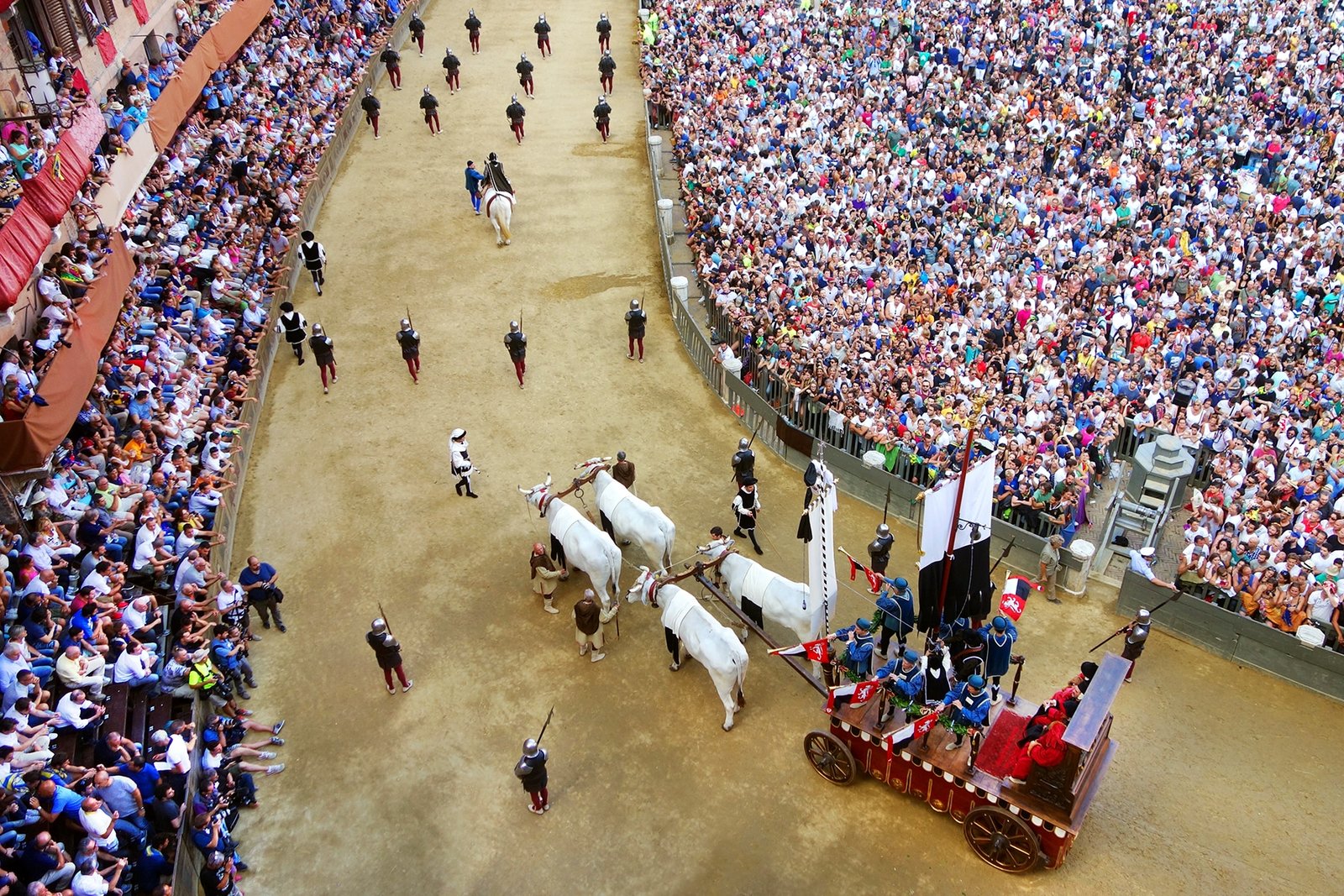
The visual splendor of the festival is anchored by an astonishing historic pageant, known as the Corteo Storico, which precedes the horse race. Over seven hundred participants dressed in immaculate, hand-stitched medieval and Renaissance costumes march into the Piazza del Campo, representing every single contrada. Noblemen, knights, guild members, and pages proudly display heraldic banners, armor, and authentic period weaponry, recreating the aristocratic and military glory of medieval Siena. This living museum of historical fashion transforms the sunlit square into a breathtaking tableau straight out of the fourteenth century.
A central highlight of the pageant is the breathtaking performance of the sbandieratori, the master flag-throwers representing the elite guilds of the various districts. As rolling drums echo off the historic stone facades, these skilled performers toss massive, richly colored silk flags high into the air, catching them behind their backs and beneath their legs with seamless precision. The complex choreography of the spinning banners creates a mesmerizing visual display of color, rhythm, and airborne athleticism that captivates the massive crowds. This ancient discipline requires years of dedicated practice, preserving a specialized acrobatic heritage passed down through generations of Sienese youth.
Every element of the pageantry is steeped in strict historical accuracy, from the heraldic trumpets blown by municipal musicians to the heavy iron maces carried by historic city officials. The procession culminates with the appearance of the Carroccio, a magnificent oxen-drawn war chariot carrying the coveted painted silk banner that serves as the ultimate prize of the competition. As the parade winds its way around the track, spectators are treated to a masterclass in civic pride, artistic preservation, and theatrical storytelling. The visual grandeur of the pageantry ensures that the festival is as much a celebration of historic art as it is a high-speed athletic contest.
- Corteo Storico: A massive historical pageant featuring over seven hundred costumed participants.
- Sbandieratori Display: Expert flag-throwers executing complex aerial choreography with silk banners.
- Medieval Armor: Authentic iron helmets, chainmail, and heraldic tunics worn by historical representatives.
- Clarion Trumpet Corps: Musicians playing traditional brass fanfares that signal the arrival of district delegations.
- The Carroccio: A grand, ox-drawn medieval war chariot carrying the prized painted silk banner.
- Guild Representation: Costumes meticulously reflecting historic medieval trade guilds and aristocratic lineages.
- Drum Corps: Rhythmic snare drumming providing an intense acoustic heartbeat for the marching processions.
- Heraldic Banners: Hand-painted silk flags showcasing the distinct crests and colors of all seventeen districts.
- Noble Court Dress: Elaborate velvet and silk Renaissance gowns worn by noblewomen representing their contrade.
- Weapons Display: Historical pikes, crossbows, and swords carried by ceremonial guards during the march.
- Choreographed Tosses: Flags launched tens of feet into the air in synchronized, sweeping patterns.
- Civic Pride: Impeccable attention to historical detail reflecting centuries of uninterrupted Sienese tradition.
Event Schedule
- Event Date: July and August 2027 (Dates TBD)
- Event Duration: Four intense days of trials, historical pageantry, and the main historic horse race per session
Visiting this event? Don’t miss out on these amazing activities and local experiences while you’re here.
Pre-Race Protocols, Prova Trials and Blessing Ceremonies
- The Tratta Lottery: Public drawing events where horses are randomly assigned to participating districts.
- Morning Trials: Early morning warm-up runs allowing jockeys to test track conditions and horse temperaments.
- Evening Prova: High-stakes evening trial heats simulating race-day pressures before massive crowds.
- The Votive Procession: Solemn religious marches offering candles and honoring historic local saints.
- Horse Blessings: Unique neighborhood rituals where each district’s horse is blessed inside local parish churches.
- Trial Strategy: Contrade deliberately conceal true tactical capabilities during early trial heats to deceive rivals.
- Veterinary Checks: Rigorous medical inspections ensuring the absolute health and safety of every competing animal.
- Jockey Hiring: District leaders negotiate confidential, high-priced contracts with elite professional jockeys.
- Banqueting Rituals: Massive communal neighborhood dinners hosted outdoors the night before the final race.
- Security Vigilance: Strict municipal oversight and round-the-clock guards protecting assigned horses from sabotage.
The days leading up to the main event are characterized by an intense, multi-day schedule of trials, religious ceremonies, and strict preparatory protocols known collectively as the Quattro Giorni. Beginning with the dramatic tratta lottery where horses are randomly distributed to the participating contrade, the atmosphere in the city shifts into high gear. Mornings and evenings feature scheduled trial runs—known as prove—where jockeys test the track conditions while districts carefully analyze the speed and temperament of their assigned animals. These trial heats serve as clandestine tactical exercises where riders test rival boundaries and hide true capabilities from their sworn enemies.
Spiritual devotion plays an equally vital role during these preparatory days, seamlessly blending pagan-like tribal passion with profound Catholic faith and historic ritualism. On the morning of the race, each participating contrada brings its horse directly into the local neighborhood church or parish oratory for an official blessing by the priest. Remarkably, horses are frequently led right up to the altar over protective carpeting while parishioners look on in reverent silence, praying for divine protection and victory. This profound integration of sacred tradition underscores how deeply the festival is woven into the spiritual and civic identity of the Sienese people.
Public pageantry intensifies daily through solemn processions, historic drum roll sequences, and official civic assemblies held within the ancient municipal palace. The eve of the main race features the final prova generale trial followed by massive open-air neighborhood dinners spanning hundreds of meters of long communal street tables. Thousands of residents sit shoulder-to-shoulder under festive lights, singing traditional district anthems and boosting the morale of their jockeys and leaders. This meticulous buildup ensures that by the time race day arrives, the emotional tension within the city has reached an absolute boiling point.
Ticket Prices
- How Tickets Are Sold: Tickets and window/balcony packages are sold online through authorized local ticket agencies, tourist operators, and official hospitality providers well in advance of the festival.
- Admission Type: Free Admission for standing in the center of the Piazza del Campo square during trials and the main race day on a first-come, first-served basis.
- Ticket Pricing: Free Admission for interior square standing areas, while seated viewing packages inside historic private windows, balconies, and grandstands range from $350.00 to over $1,650.00 per person.
- Special Seating Options: Elevated grandstand seats positioned along the perimeter of the track offer structured views of the dangerous turns and high-speed racing action.
- VIP Options: Exclusive VIP hospitality packages ranging from $1,800.00 to $4,500.00 include luxury indoor balcony catering, private historical tour guides, and premier sightlines overlooking the finish line.
Piazza del Campo Track Dynamics and Race Rules
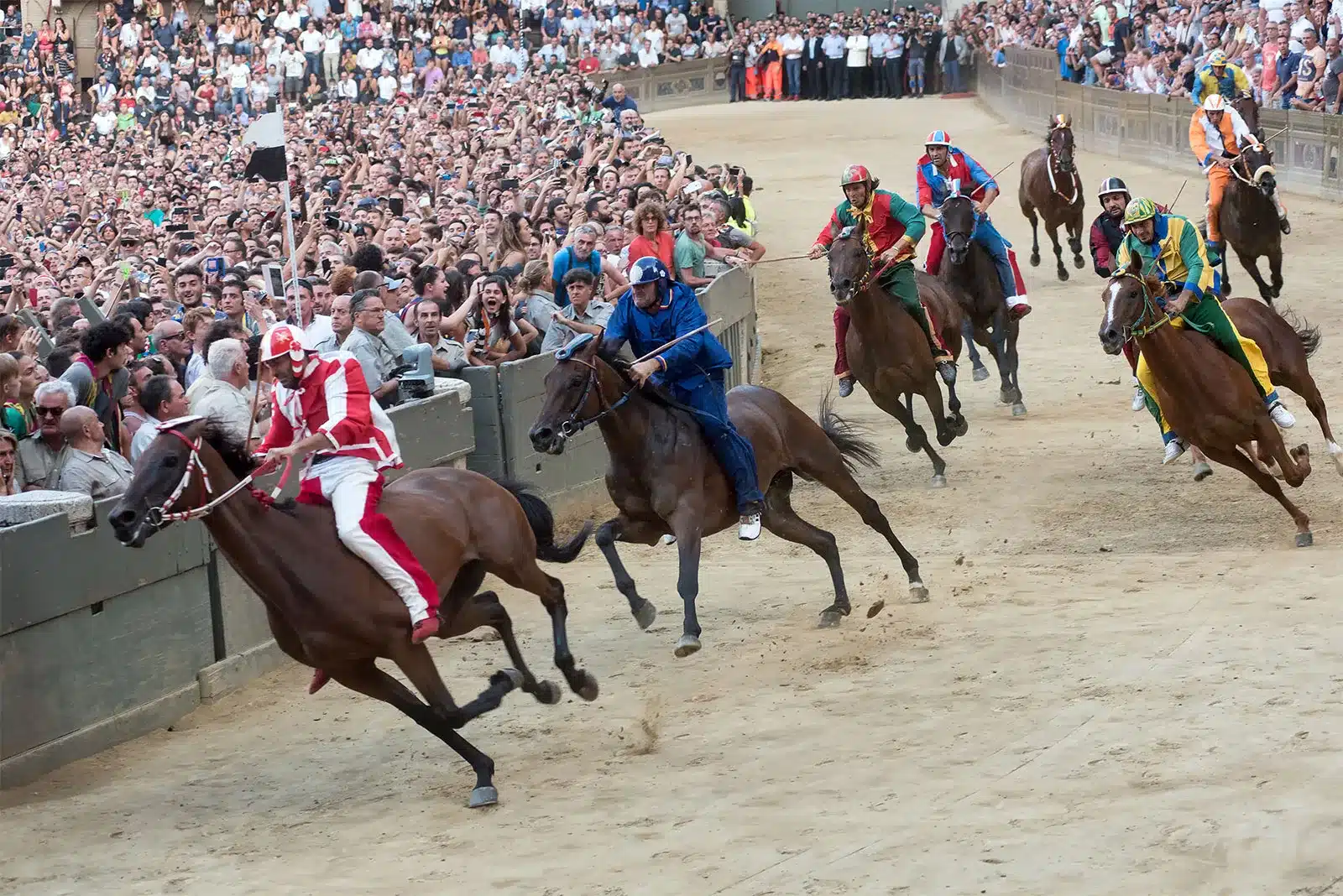
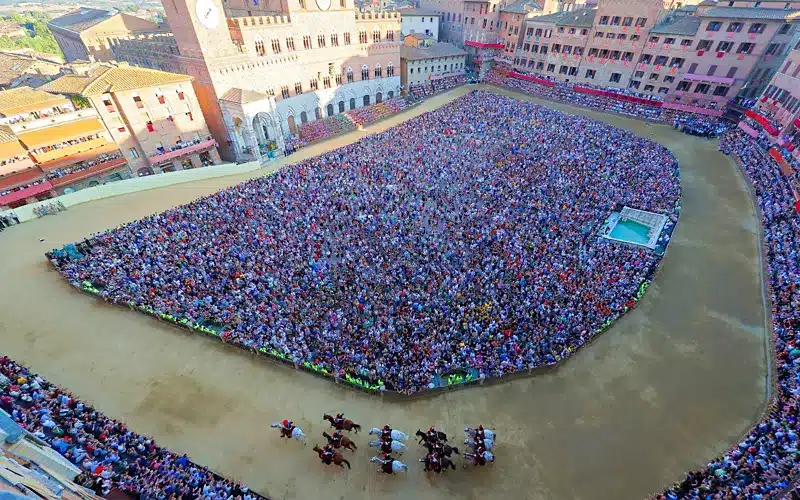
The physical battleground of the race is the Piazza del Campo, Siena’s magnificent shell-shaped central piazza, which undergoes a dramatic physical transformation weeks prior to the competition. Tons of specially selected earth and albero sand are hauled into the medieval square and laid down in a thick, uniform layer over the stone paving blocks. Wooden barriers wrapped in protective matting are erected along the perimeter of the steep track, curving sharply around dangerous architectural bottlenecks like the treacherous San Martino bend. This temporary circuit demands extreme technical mastery and raw courage from both horses and jockeys navigating the tight, sloping turns at breakneck speeds.
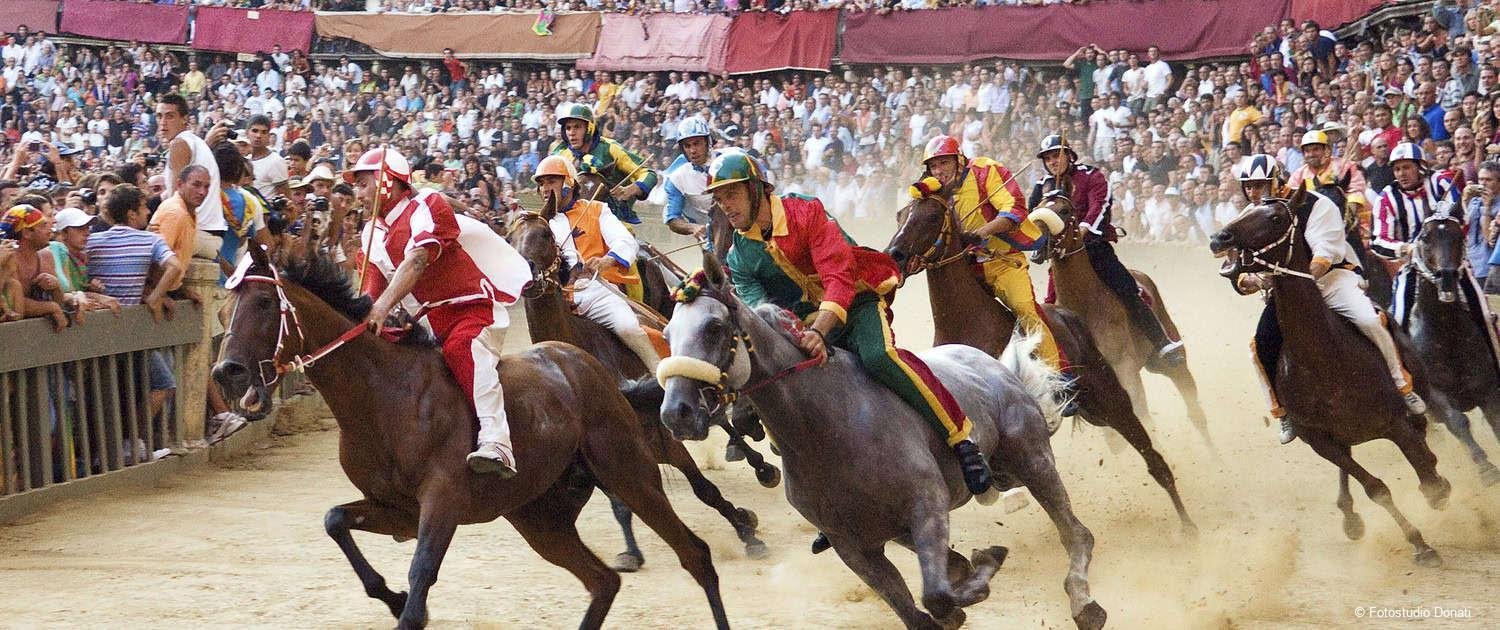
The rules governing the race itself are notoriously minimal and brutally unforgiving, establishing a chaotic environment where almost anything is legally permitted once the explosive starter’s signal sounds. Ten of the seventeen contrade participate in each race—seven automatically entering alongside three others drawn by a random public lottery held weeks beforehand. The jockeys ride their assigned horses completely bareback, wearing protective helmets and colorful silk jackets representing their respective districts while wielding heavy oxhide whips. These whips are used not only to urge the animal forward but also to strike competing horses and opposing riders in a desperate bid for supremacy.
Tactics during the three frantic laps around the square often revolve around jockey alliances, tactical blockades at the starting ropes, and physical confrontations right on the sandy track. Because the start of the race is determined by an unpredictable lottery order at the ropes, a clever jockey can delay the start for hours to disrupt opposing strategies. Once the explosive petardo firecracker signals a clean start, riders must survive perilous collisions, sudden falls on the tight corners, and aggressive blocking maneuvers by rival camps. The race is notoriously brief, typically lasting around ninety seconds, yet it encapsulates a lifetime of preparation, tension, and unbridled ambition.
Even the horses crossing the finish line without their riders—known locally as the contradiaioli or riderless horses—are fully eligible to win the historic silk banner if they finish ahead of the pack. This bizarre yet vital rule emphasizes that the victory belongs fundamentally to the contrada and its assigned animal rather than the individual human athlete. The chaotic nature of the finish frequently leads to immediate track invasions, euphoric celebrations by the winning district, and immediate tactical post-mortems by the losers. Mastering the physical dynamics of the Campo requires an intimate understanding of shifting footing, centripetal force, and the unyielding ruthlessness of Siena’s premier sporting tradition.
- Track Surface: Specialized albero sand and earth layered heavily over the historic stone piazza paving.
- San Martino Bend: A notoriously sharp, dangerous corner where horses frequently lose footing under pressure.
- The Starting Ropes: Two parallel ropes managed by a designated starter regulating the chaotic entry order.
- Bareback Riding: Jockeys compete without saddles, demanding extraordinary balance and core strength.
- Oxhide Whips: Heavy leather crops utilized aggressively against competing horses and opposing riders.
- Three Laps: Competitors must complete three full circuits around the perimeter of the sloping shell square.
- Riderless Victories: Horses finishing unseated can still secure official victory for their district.
- Lottery Allocation: Ten competing districts are selected via a public draw prior to each race event.
- Duration: The entire high-speed contest concludes in approximately ninety seconds of frantic action.
- Protective Padding: Heavy straw-and-mattress installations cushion the unforgiving masonry walls along the turns.
- Starting Delays: Jockeys can stall the official start for hours through tactical positioning at the ropes.
- Post-Race Chaos: Immediate track invasions by jubilant winning supporters overwhelm the historic square.
Biannual Race Schedule for July and August
- Biannual Structure: The festival occurs twice every summer, anchoring the regional cultural calendar in mid-summer.
- July Edition: The first race runs annually on the second day of July in honor of the Madonna of Provenzano.
- August Edition: The second race takes place on the sixteenth day of August celebrating the Assumption of Mary.
- Preparation Cycles: Each race is preceded by months of secret committee meetings, jockey negotiations, and neighborhood fundraising.
- Summer Peak: The dates coincide with peak European tourism seasons, bringing massive global crowds into the Tuscan hills.
- Independent Events: Each of the two races functions as a completely autonomous competition with its own unique winner.
- Identical Rituals: Both July and August editions follow the exact same rigid four-day schedule of trials and pageantry.
- Climatic Challenges: Summer heatwaves across the Tuscan stone piazza demand exceptional physical endurance from athletes and animals.
- Consecutive Tensions: Winning both races in a single calendar year—known as a cappotto—remains an extraordinarily rare achievement.
- Seasonal Finale: The August race marks the grand emotional crescendo of the Tuscan summer festival calendar.
The rhythmic cycle of the festival is defined by its unique biannual structure, staging two completely independent race events during the height of the Tuscan summer. The first competition takes place in early July, dedicated historically to the Madonna of Provenzano, while the second event runs in mid-August in honor of the Assumption of Mary. Each race operates as an entirely self-contained festival complete with its own four-day cycle of trials, pageantry, tension, and triumphant celebration. This dual-season format doubles the emotional stakes for the seventeen contrade, offering a second chance at glory for those who suffer heartbreak earlier in the summer.
Organizing two massive historic spectacles within a six-week window requires extraordinary logistical coordination from municipal authorities, veterinary boards, and neighborhood committees. The city must seamlessly transition from cleaning up the chaotic euphoria of the July victory straight into the secretive, tense preparations for the August draw. Tourists and global travelers flock to Siena in the millions during this period, transforming the medieval alleys into a bustling melting pot of international culture and local tribalism. Despite the commercial tourism surrounding the events, the core spiritual and competitive traditions remain fiercely protected by the local Sienese populace.
Achieving victory in both summer races within the same calendar year is an exceedingly rare feat known as a cappotto, an accomplishment that elevates a winning contrada to near-mythological status. When a district manages this double triumph, the subsequent neighborhood celebrations can literally last for months, echoing through the historic streets well into the autumn months. Even in standard years, the rhythm of the biannual schedule provides an unyielding heartbeat that structures the social and cultural life of Siena year after year. It is a timeless cadence that ensures the city’s medieval heritage remains vibrantly alive in the modern world.
Getting to the Venue
- City and Country: Siena, Italy
- Venue Name: Piazza del Campo
- Google Maps Address: Il Campo, 53100 Siena SI, Italy
Worried about accommodation? Hotels near this event sell out quickly, and prices tend to rise fast. Check out these accommodation options:
Event Information
- Email: info@paliodisiena.tickets
- Phone Number: +39 0577 1607558
- Website: https://paliodisiena.tickets/
Tickets Sell Out
in Minutes
Maps
Contact
Video
FAQ's
What makes the historic horse race unique compared to modern sporting events?
The competition is fundamentally driven by deep neighborhood rivalries and tribal loyalty rather than corporate sponsorship or standard athletic rules. Jockeys ride completely bareback around a dangerous stone-paved square while utilizing heavy oxhide whips against competitors. The victory belongs ultimately to the historic district and its assigned horse rather than the individual human rider.
Can anyone witness the race from inside the central piazza square?
General public access to the dirt-covered interior of the Piazza del Campo is completely free of charge on a first-come, first-served basis. Spectators must arrive hours in advance and endure intense summer heat while standing shoulder-to-shoulder within the massive crowd enclosure. Security gates close permanently once maximum capacity limits are reached ahead of the pageantry.
How are the competing districts chosen for each summer race?
Seven participating contrade gain automatic entry based on their participation status from the corresponding race of the previous year. The remaining three open slots are allocated through a public lottery drawing held weeks prior to the festival start. This random selection process ensures that every district eventually gets its chance to compete on the historic track.
What happens if a jockey falls off their horse during the race?
Rules explicitly state that a horse crossing the finish line without its rider—known as a riderless horse—can still win the official banner. This unusual regulation emphasizes that the glory is secured by the animal and the district rather than the athlete. Such dramatic occurrences have historically resulted in shocking upsets and unforgettable underdog victories.
How do the local districts care for their assigned horses?
Each contrada houses its assigned horse in dedicated, heavily guarded stables overseen by specialized veterinary surgeons and loyal district members. Round-the-clock security watches protect the animals from potential sabotage or stress leading up to the main event. The horses receive meticulous daily grooming, specialized feeding schedules, and private church blessings before the race.
Where can visitors purchase seats with optimal views of the action?
Reserved seating options include historic windows, elevated wooden grandstands, and private balconies overlooking the track perimeter managed by agencies. These prime viewing spaces must be booked many months in advance due to extremely high global demand and limited physical capacity. Standholders enjoy uninterrupted sightlines above the dense crowds packed into the square below.