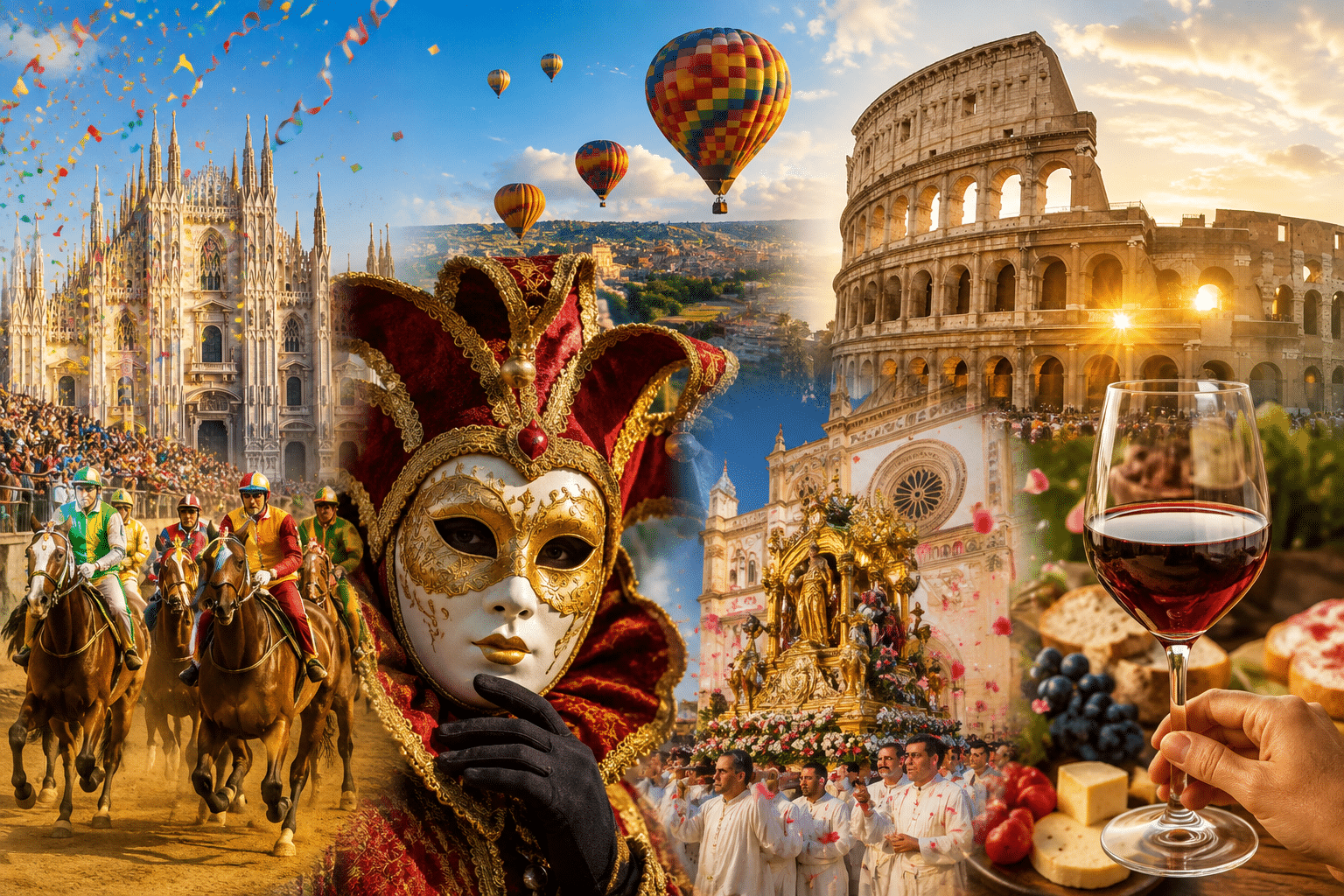
Italy doesn’t just do festivals — it does spectacle. From medieval knights racing through cobblestone streets to opera singers performing on cliffside stages above the Mediterranean, the Italian calendar is packed with celebrations that turn entire towns into stages. Whether you’re chasing confetti-drenched carnival parades, world-class jazz, or the smell of melting chocolate drifting through a hillside city, 2026 offers no shortage of reasons to plan a trip around Italy’s festival season.
Here are ten of the best — spanning the whole calendar year, from the frost of February carnivals to the crisp air of an autumn chocolate fair.
1. Carnevale di Viareggio — Viareggio, Tuscany (February)
Few festivals in the world rival the scale and satire of Viareggio’s Carnival. Since 1873, this Tuscan seaside town has built enormous papier-mâché floats — some three stories tall — that skewer politicians, celebrities, and global headlines with biting good humor. The floats parade along the seafront promenade to live music, fireworks, and a crowd that grows every weekend of the festival. It’s part parade, part political cartoon, and entirely unforgettable. If you only see one Italian carnival this year, this is a strong contender — full event details, including this year’s parade dates, are on Italy Travelo’s Carnevale di Viareggio listing.
Enjoy Your Event Stress-Free with Euro Travelo
Planning a trip to attend a festival, concert, or business event in Europe can be overwhelming—tickets, travel, accommodation, and local logistics all take time and effort. Euro Travelo makes it simple by providing everything you need through one trusted company. You save time, avoid stress, and enjoy a seamless experience from start to finish.
2. Venice Carnival — Venice, Veneto (February)
No list of Italian festivals is complete without Venice’s legendary Carnevale. For roughly two weeks before Lent, the city’s canals and piazzas fill with masked figures in elaborate 18th-century costume — velvet cloaks, gilded masks, powdered wigs — turning Venice into a living painting. Beyond the famous masquerade balls (some ticketed, many free to watch), look for the “Flight of the Angel,” where a costumed performer descends by wire from the Campanile into St. Mark’s Square to open the festivities. Book accommodation early; this is one of Europe’s most photographed events, and rooms disappear months in advance. Browse other Venice happenings on Italy Travelo’s Venice city page.
3. Calendimaggio di Assisi — Assisi, Umbria (May)
Calendimaggio transforms the hilltop town of Assisi into a medieval battlefield — of song and pageantry, not swords. The town splits into two rival factions, Parte de Sopra and Parte de Sotto (Upper and Lower districts), who compete across days of costumed processions, torch-lit performances, archery contests, and choral singing in the town’s stone piazzas. Rooted in medieval spring rites and later fused with a tribute to St. Francis, it’s one of Umbria’s most atmospheric traditions — best experienced at night, when the entire historic center glows by torchlight. Full listing and dates on Italy Travelo.
4. Ravello Festival — Ravello, Amalfi Coast (June–September)
There may be no more dramatic concert setting on earth than the Ravello Festival’s open-air stage, cantilevered off a cliff above the Tyrrhenian Sea. Founded in homage to composer Richard Wagner, who was famously inspired by the gardens of Villa Rufolo, the festival now spans classical music, ballet, jazz, and film across the summer months. Performances at the Auditorium Oscar Niemeyer — a striking modern structure designed by the Brazilian architect — pair world-class acoustics with a backdrop of the Amalfi coastline that’s hard to beat with a camera, let alone a description.
5. Umbria Jazz Festival — Perugia, Umbria (July)
For ten days each July, Perugia becomes one of Europe’s jazz capitals. Umbria Jazz has hosted icons from Miles Davis to Chick Corea since the 1970s, and today mixes ticketed evening concerts with free street performances that spill through the city’s medieval piazzas and arcades. Between sets, Perugia’s hilltop old town — all stone stairways, gelato shops, and Etruscan gates — makes for one of Italy’s most pleasant places to simply wander. It’s proof that Italian festival culture isn’t only about tradition; it’s also about global music on a genuinely world-class stage.
6. Palio di Siena — Siena, Tuscany (July & August)
Twice each summer, Siena’s shell-shaped Piazza del Campo is packed with dirt, cheering crowds, and ten bareback riders thundering around the square in a horse race that lasts barely ninety seconds — and means everything to the city. The Palio represents Siena’s seventeen historic contrade (neighborhoods), each with centuries of rivalry, its own flag, and passionate loyalty passed down through generations. The race itself is over in a flash, but the days leading up to it — trial runs, blessing ceremonies inside neighborhood churches, and a spectacular historical procession in medieval costume — are where the real theater happens.
7. Festa dei Gigli — Nola, Campania (June)
In the small Campanian town of Nola, teams of shirtless men carry eight towering wooden spires — some over 25 meters tall and weighing several tons — through the streets on their shoulders, hoisting and swaying them to live brass bands in a display of raw strength and devotion. Dating back over a thousand years and honoring the town’s patron saint, San Paolino, Festa dei Gigli is intense, loud, and deeply communal — a festival built entirely by and for the townspeople rather than for visitors, which is exactly what makes witnessing it so compelling.
8. Bravìo delle Botti — Montepulciano, Tuscany (August)
Part sporting event, part wine celebration, the Bravìo delle Botti sees teams from Montepulciano’s eight historic districts race 80-kilogram wine barrels uphill through the town’s steep medieval streets, pushing and rolling them by hand to the finish line. It’s chaotic, competitive, and thoroughly Tuscan — set against a town famous for its Vino Nobile wine, with tastings and feasting filling the days around the race itself. Come for the barrel race, stay for the cellar tours.
9. Color Fest — Lamezia Terme, Calabria (August)
For a livelier, more contemporary festival experience, Color Fest brings a beachfront explosion of music and color powder to Calabria’s Ionian coast. Set along the Falcone and Borsellino seafront, it blends live DJ sets and concerts with the kind of high-energy, color-throwing atmosphere that’s become popular at festivals worldwide — but with an unmistakably southern Italian backdrop of sea, sun, and late-summer heat. It’s a great pick for travelers who want a younger, more festival-scene experience alongside Italy’s historic traditions.
10. Eurochocolate — Perugia, Umbria (October/November)
Closing out the festival year on a sweeter note, Eurochocolate takes over Perugia’s historic center each autumn with chocolate sculptures, tastings, workshops, and stalls from artisan chocolatiers across Italy and beyond. What began as a niche local event has grown into one of Europe’s largest chocolate festivals, drawing hundreds of thousands of visitors to wander the same medieval streets that host Umbria Jazz each summer — proof that Perugia knows how to throw a festival in any season.
Planning Tips for Italy’s Festival Season
Book early for anything in Venice, Siena, or the Amalfi Coast. These are among Italy’s most visited regions even outside festival dates, and accommodation during Carnevale, Palio, or Ravello Festival weekends can sell out four to six months ahead.
Pack for crowds, not just weather. Many of these festivals — especially Calendimaggio, Festa dei Gigli, and the Palio — take place in tight medieval streets and squares. Comfortable shoes and a willingness to stand for a few hours will serve you better than a packed itinerary.
Mix the famous with the local. Venice Carnival and the Palio di Siena are unmissable, but some of the most memorable experiences on this list — Festa dei Gigli, Bravìo delle Botti, Color Fest — are still relatively under-the-radar for international visitors, which often means a warmer, more genuine welcome.
Check dates every year. Many of these festivals move slightly from year to year depending on the liturgical calendar (Carnival and Calendimaggio in particular) or local scheduling. Always confirm current dates before booking travel.
Final Thoughts
What makes Italy’s festival calendar so remarkable isn’t just the spectacle — it’s how deeply local these events remain, even the ones drawing international crowds. A carnival float in Viareggio, a wine barrel race in Montepulciano, a wooden spire hoisted through Nola’s streets: these are traditions built by residents, for their own communities, that happen to be extraordinary to witness as an outsider.
If you’re planning a 2026 trip around any of these celebrations, Italy Travelo is a useful place to start — with up-to-date listings, dates, and locations for festivals across the country, plus support for accommodation, transport, and event tickets once you’ve picked your dates.