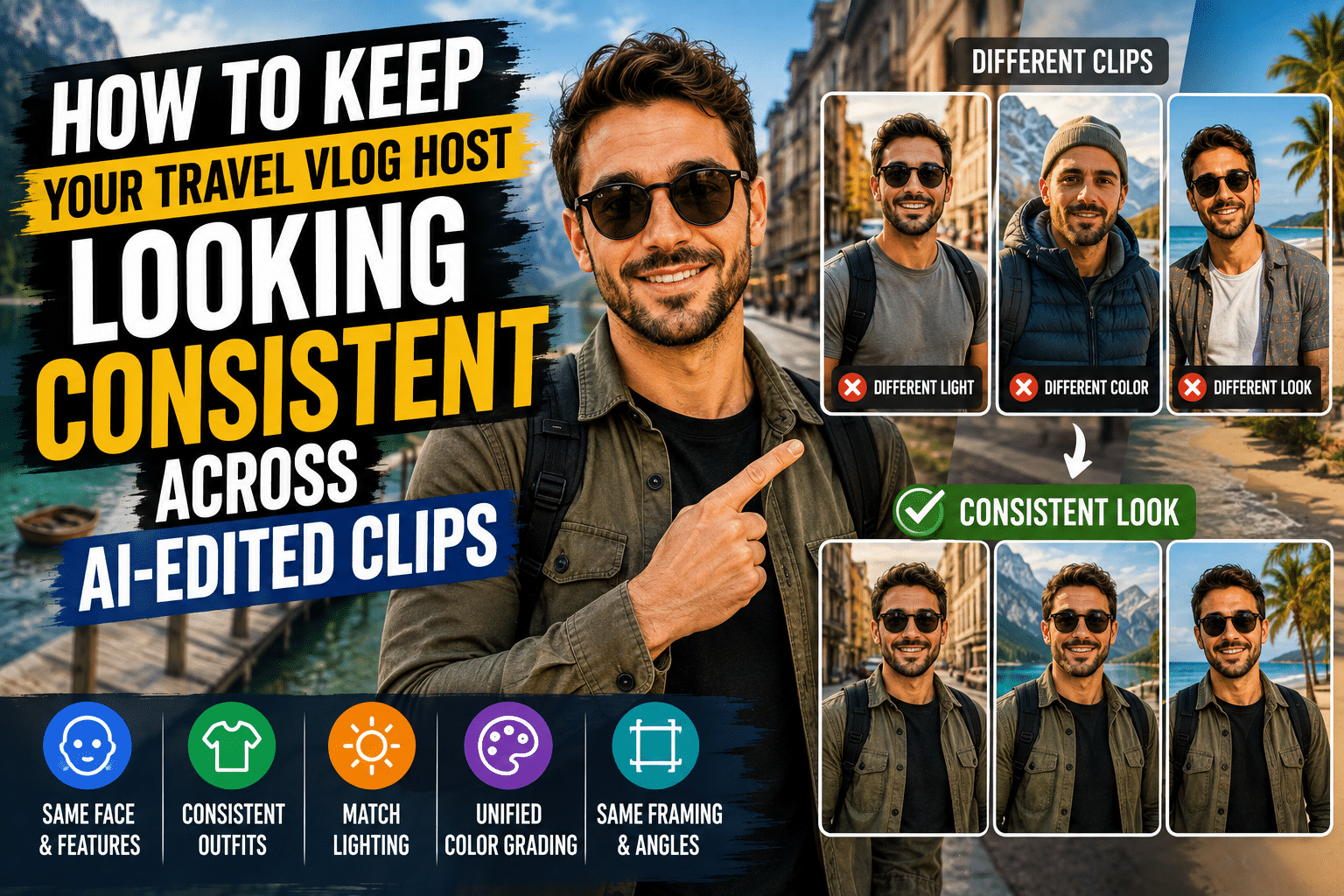
A travel vlog has a specific consistency problem most other video formats don’t: the host is real, but the lighting, location, and shooting conditions change constantly, sometimes within the same day. Bright beach footage at noon, a dim restaurant that evening, a hotel room lit by one lamp the next morning. The host is the same person throughout, but if every clip’s color, tone, and edit style shifts along with the location, the vlog stops feeling like one continuous trip and starts feeling like disconnected footage stitched together.
This isn’t really a “character consistency” problem the way a generated character has, since the host is a real person on camera. It’s a color, tone, and branding consistency problem, and it needs to be solved differently.
Why travel footage drifts more than almost any other format
Most video formats control their lighting: a studio interview, a scripted narrative, even a corporate explainer are usually shot under conditions the crew chose. Travel vlogging works the opposite way, shooting whatever light and location exist at that moment of the trip, which means the raw footage arrives already inconsistent before any editing happens. AI editing tools can smooth that inconsistency out, but only if the process treats it as the specific problem it is, rather than expecting a general-purpose edit to fix it automatically.
Enjoy Your Event Stress-Free with Euro Travelo
Planning a trip to attend a festival, concert, or business event in Europe can be overwhelming—tickets, travel, accommodation, and local logistics all take time and effort. Euro Travelo makes it simple by providing everything you need through one trusted company. You save time, avoid stress, and enjoy a seamless experience from start to finish.
Establish one color identity before the trip, not after
The mistake that’s easiest to make is treating color correction as a per-clip decision made in the edit bay after everything’s already shot. A stronger approach decides the vlog’s overall color identity, warm and saturated, cool and clean, filmic and desaturated, before the trip even starts, then applies that same target consistently across every location’s footage rather than grading each clip to look good in isolation.
An AI color-matching tool can automate the mechanical side of this once the target look is decided: analyzing footage from different cameras and lighting conditions and batch-applying a consistent grade across the whole timeline, rather than a colorist manually correcting each clip to a slightly different standard.
Separate “the host looks the same” from “the footage feels the same”
It’s worth being precise about what actually needs to stay consistent here. The host’s face, build, and general appearance don’t need any special AI intervention, they’re the same real person on camera regardless of location. What needs deliberate consistency work is everything around them: the color grade, the audio levels, the pacing of cuts, and any recurring graphic elements, lower thirds, intro and outro cards, that brand the series as one continuous show.
Confusing these two problems, treating a location or lighting change as if it were a character-consistency issue, leads to solving the wrong thing. The host doesn’t need to be regenerated or locked with a reference sheet. The footage around them needs a consistent finishing pass.
Match audio levels as a separate step from color
A beach location and a quiet hotel room don’t just look different, they sound completely different: wind noise, street traffic, air conditioning hum, all sitting at different natural volumes before any editing. A vlog that nails color consistency but leaves audio levels bouncing between loud, windy exteriors and quiet, close-mic’d interiors still feels inconsistent to a viewer, just through a different sense than sight.
Normalizing loudness to one consistent target across the whole edit, and cleaning up each location’s specific noise profile individually rather than applying one generic filter to everything, closes a gap that color grading alone doesn’t solve.
Keep the recurring branded elements identical across every episode
A travel vlog series usually has recurring visual elements that aren’t the host or the footage at all: an intro card, a lower-third graphic showing the current location, an outro with a subscribe prompt. These need to be pixel-identical episode to episode, precisely because they’re the one part of the show that isn’t supposed to vary with the location.
This is where invideo agent fits a travel vlog workflow specifically: rather than rebuilding an intro or lower-third graphic manually for every new location, a persistent context engine holds that branded visual identity consistent across every episode generated inside the same project, while the platform routes each generated element to whichever of its 200+ integrated models fits, including Veo 3.1, Sora 2, Kling 3.0, Seedance 2.5, Runway, PixVerse, Hailuo, WAN, Recraft, GPT Image 2.0, and Nano Banana. The real travel footage still comes from the camera; the recurring branded elements around it stay locked from one project.
Common mistakes when editing a travel vlog series with AI tools
- Treating color correction as a per-clip decision instead of a series-wide identity. Grading each clip to look good in isolation, rather than to a consistent target, is how a vlog ends up feeling like disconnected footage rather than one continuous trip.
- Confusing “the host looks different” with “the footage feels different.” The host doesn’t need character-consistency tools; the footage around them needs a consistent color and audio finishing pass.
- Assuming color consistency automatically fixes audio consistency. They’re separate problems. A vlog can look uniform and still sound jarring if loudness and noise profiles between locations aren’t addressed on their own.
- Rebuilding intro cards and lower-third graphics manually for every new episode. These recurring branded elements are exactly the part of a series that should stay pixel-identical, and manually recreating them invites small inconsistencies to creep in.
- Not deciding the vlog’s color identity until after the trip is shot. Choosing a target look before filming, even loosely, gives every location’s footage something consistent to be graded toward, rather than grading reactively after the fact.
Frequently asked questions
Does a travel vlog host actually need AI character-consistency tools? No, not in the way a fully AI-generated character does. The host is a real person filmed on camera, so their appearance is already consistent by default. What actually needs deliberate consistency work is the footage’s color, audio, and recurring branded elements around them.
Why does travel footage need more color correction work than other video formats? Because travel vlogging shoots under whatever lighting exists at each location and moment, rather than controlled studio conditions. That means the raw footage starts out visually inconsistent before any editing happens, which is different from a scripted format shot under conditions the crew chose in advance.
Should audio and color be fixed in the same editing pass? They’re better treated as separate steps, even though they’re both part of the same finishing process. A vlog can achieve a consistent color grade and still feel inconsistent to a viewer if loudness and background noise profiles between locations aren’t addressed on their own.
How can recurring intro cards and lower-third graphics stay identical across a whole series? This is specifically what invideo agent’s persistent context engine is built for, holding a branded visual identity consistent across every episode generated inside the same project, rather than manually rebuilding those recurring elements for each new location.
Is it better to decide a vlog’s color identity before or after the trip? Before, if possible, even if only loosely. Deciding on a warm, cool, or filmic target look ahead of time gives every location’s footage a consistent standard to be graded toward, rather than reactively correcting each clip in isolation after the trip is already shot.