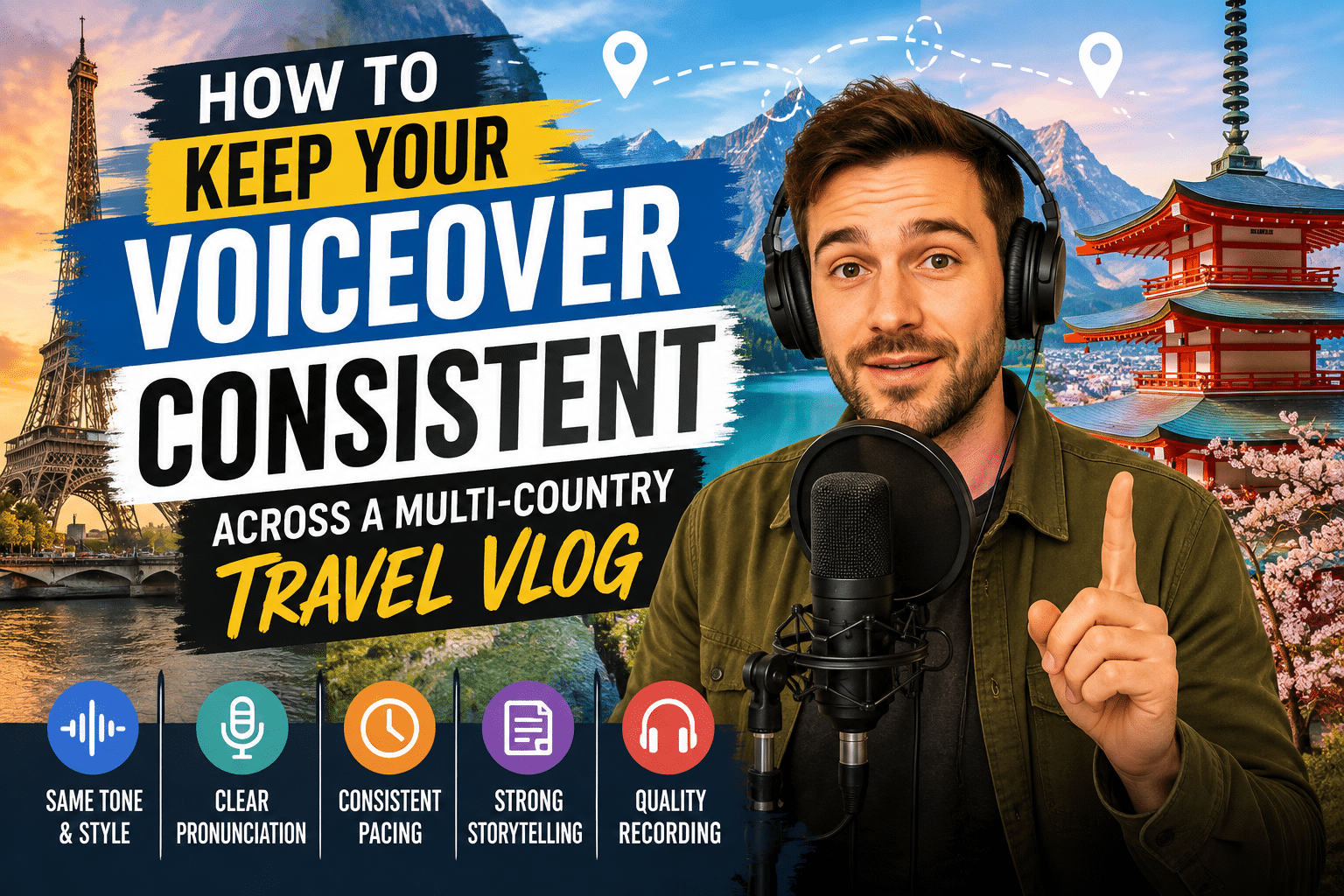
A multi-country trip adds a specific complication to voiceover consistency that a single-location shoot never runs into: the narration gets recorded across weeks, in a rotating set of hotel rooms, guesthouses, and borrowed quiet corners, each with its own acoustic signature, and often with real gaps in energy and pacing between sessions recorded in different time zones and states of jet lag. The result, without deliberate planning, is a voiceover that sounds like it was stitched together from several different recording sessions, because it was.
This is a genuinely different problem from keeping a single studio-recorded narration consistent. The recording environment itself is the variable, not just the performance.
Why a multi-country trip is uniquely hard on voiceover consistency
A narrator recording in one studio across one production period deals with one set of variables. A narrator recording pickup lines and reflections across a multi-country trip deals with a rotating recording environment, different room sizes, different levels of ambient noise, different microphone setups if equipment varies by location, on top of the ordinary challenge of sounding like the same person take to take. Weeks between sessions also means energy and pacing naturally drift as the trip itself changes mood, exhausting one week, exhilarating the next.
Enjoy Your Event Stress-Free with Euro Travelo
Planning a trip to attend a festival, concert, or business event in Europe can be overwhelming—tickets, travel, accommodation, and local logistics all take time and effort. Euro Travelo makes it simple by providing everything you need through one trusted company. You save time, avoid stress, and enjoy a seamless experience from start to finish.
None of this means consistency is impossible. It means the plan for achieving it needs to account for a rotating environment from the start, rather than assuming the same approach that works for a single-location production will translate directly.
Build the voice reference before departure, in a controlled environment
Whatever technique will hold the narration consistent, whether that’s a trained voice model or simply a performer’s own disciplined delivery, needs a clean, controlled reference recorded before the trip’s chaotic recording conditions begin. A reference captured in a proper quiet space, with a real microphone, gives every later session, recorded in whatever hotel room the trip provides, something stable to be matched against.
Skipping this step and treating the first location’s recording as the de facto reference means that reference itself already carries that location’s specific room tone, which every later location then has to match instead of a genuinely neutral baseline.
Match room tone deliberately when pickup lines get recorded on the road
A line recorded in a Bangkok guesthouse and a line recorded in a Lisbon hotel room will carry different reverb and ambient character even if the narrator’s performance is identical. This is a mechanical, fixable problem rather than a performance one: analyzing a reference recording’s room tone and reverb, then applying that same acoustic signature to a later pickup line, closes the gap between two genuinely different physical spaces.
This step matters more the longer the trip runs and the more locations the narration touches, since each new environment is one more acoustic signature that needs reconciling with all the others.
Normalize levels across sessions recorded weeks apart
Beyond room tone, raw recording levels tend to drift across a long multi-country production simply because of inconsistent equipment setup, different rooms’ natural noise floors, and a narrator who isn’t monitoring levels with studio precision from a hotel room. Normalizing loudness to one consistent target across the entire vlog series, rather than assuming each session was recorded at a comparable level, catches a gap that’s easy to miss until the whole series is played back to back.
Plan for multi-language localization from the start, not as an afterthought
A vlog that spans multiple countries often needs to reach more than one language audience, and a straightforward, unrelated voiceover in each new language for each country’s episode risks sounding like an entirely different narrator across the series. The more reliable approach plans localization at the same time as the original narration, rather than treating each language version as its own separate production.
invideo agent handles this directly: it plans what has to change versus stay the same across a translation, auto-translates the narration, generates lip-synced voiceover, and uses voice cloning to keep the same voice consistent across every language version, so a multi-country vlog’s narrator sounds like the same person whether the episode is being watched in the original language or a localized one. This sits on top of the platform’s routing across whichever of its 200+ integrated models fits a given scene, including Veo 3.1, Sora 2, Kling 3.0, Seedance 2.0, Runway, PixVerse, Hailuo, WAN, Recraft, GPT Image 2.0, and Nano Banana, so the voice identity carries consistently regardless of which model handles the visuals for a given country’s footage.
Common mistakes when keeping voiceover consistent across multiple countries
- Using the first location’s recording as the de facto reference. That reference then carries its own room tone, which every later location has to match instead of a genuinely neutral baseline recorded before the trip began.
- Assuming a consistent performance automatically means consistent acoustics. Two recordings can be performed identically and still sound like different rooms if their reverb and ambient character aren’t deliberately matched.
- Not accounting for energy drift across a weeks-long production. A trip’s own mood, exhausting stretches, exhilarating ones, naturally bleeds into a narrator’s pacing and tone session to session if it isn’t consciously managed.
- Treating each country’s localized voiceover as a separate, unrelated production. Without planning localization alongside the original narration, translated versions tend to sound like a different narrator rather than the same voice in another language.
- Skipping level normalization across sessions recorded on inconsistent equipment. Hotel-room recording setups vary trip to trip, and assuming every session was captured at a comparable level is a common source of an inconsistent final mix.
Frequently asked questions
Why is voiceover consistency harder on a multi-country trip than a single-location production? Because the recording environment itself keeps changing, a rotating set of hotel rooms and borrowed quiet spaces each with their own acoustic character, on top of the ordinary challenge of consistent performance. A single-location production only has to solve the performance side of that problem.
What’s the single most important step to take before a multi-country trip starts? Recording a clean, controlled voice reference in a proper quiet space before departure. Every later session recorded on the road then has something stable to be matched against, rather than the first location’s room tone becoming the accidental baseline.
Can room tone actually be matched between two completely different recording environments? Yes. Analyzing a reference recording’s room tone and reverb and applying that same acoustic signature to a later pickup line is a mechanical, fixable process, not something that requires re-recording in matching physical spaces.
Should a multi-country vlog be voiced in multiple languages, and does that break consistency? It doesn’t have to. Planning localization alongside the original narration, rather than treating each language as a separate production, is what keeps a narrator sounding like the same person across languages. invideo agent’s auto-translation and voice cloning are built specifically to preserve that identity across every language version.
How much does a narrator’s energy actually drift across a long trip, and does it matter? More than most narrators expect, since a trip’s own mood naturally bleeds into pacing and tone session to session. It matters because a viewer watching the finished vlog back to back notices that drift even if no single session sounds wrong in isolation.